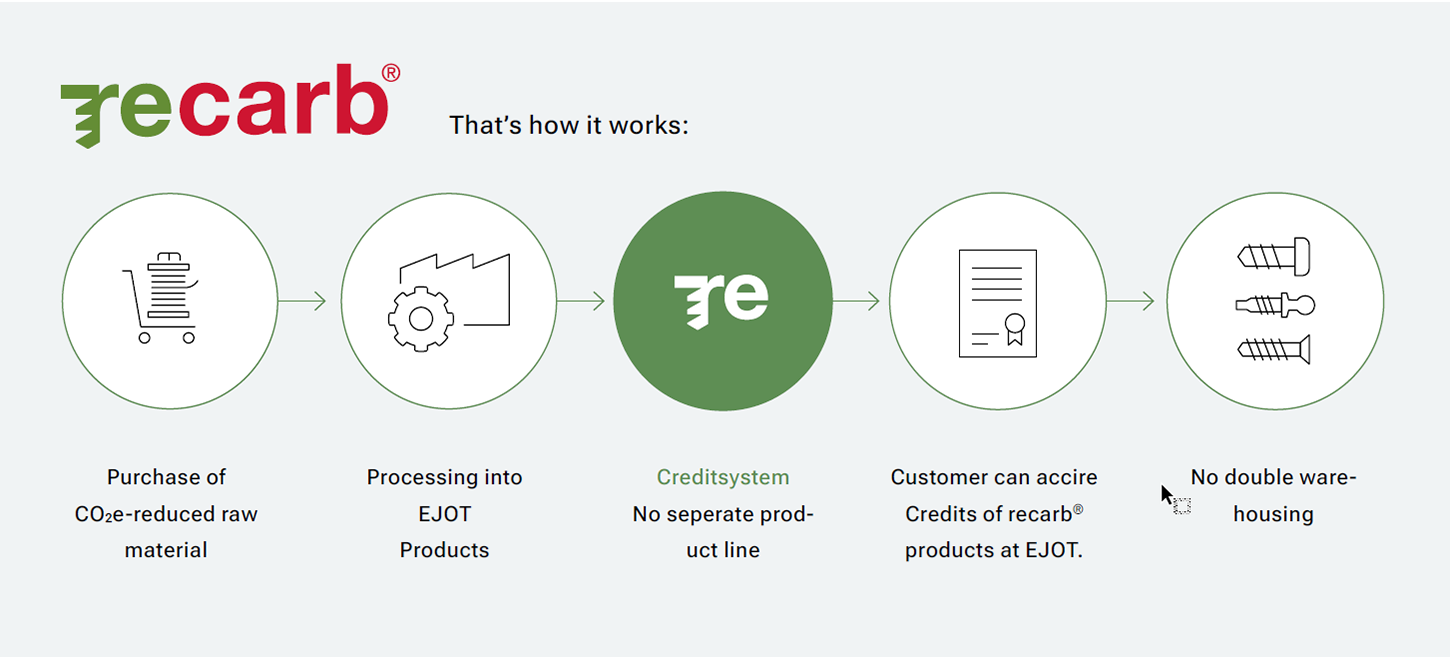

The recarb® principle: Closed-loop systems for future-proofed products
What is the recarb® principle?
How can CO₂ emissions be reduced in industrial fastening technology and the construction industry without compromising on safety, quality or cost-effectiveness? It is precisely this question that lies at the heart of EJOT’s recarb® principle.recarb® is not a single product, but a holistic approach to the sustainable optimisation of products and processes. The aim is to systematically reduce environmental impacts throughout the entire product lifecycle – from the selection of raw materials to performance in use. All measures are based on measurable data and remain technically and economically viable.
Why is recarb® relevant for businesses?
For buyers, engineers and Sustainability Manager, the pressure to make well-informed and sustainable decisions is growing. At the same time, technical requirements, costs and regulatory standards must be met.recarb® supports companies precisely in this regard: through transparent data, comparable metrics and a clearly structured approach to emissions reduction. Companies gain a robust basis for decision-making – whether in procurement, product development or sustainability reporting.
How are raw materials optimised under the recarb® principle?
A key lever lies in the management of resources. recarb® starts right at the source of each product by reducing the proportion of primary raw materials and supplementing them with high-quality secondary materials.For each product group, a targeted assessment is carried out to determine which material solutions are technically suitable, economically viable and available in the long term. This results in a stable material mix that offers ecological benefits without compromising industrial feasibility.
How is sustainability made measurable?
Sustainability only realises its value when it is traceable and comparable. That is why recarb® creates a uniform data foundation.Product Carbon Footprints (PCF) enable the transparent presentation of a product’s carbon footprint across its entire life cycle. In addition, Environmental Product Declarations (EPD) provide standardised and reliable environmental information. These are supplemented by practical performance indicators, enabling well-founded and audit-proof decisions.
How is product performance ensured?
A key principle of recarb® is that sustainability does not come at the expense of product performance. Materials and processes are optimised so that they continue to meet the highest standards of safety, functionality and service life.In both the construction industry and industrial fastening technology, the products remain reliable in use and are designed to remain in the usage cycle for as long as possible. Sustainability thus becomes an integral part of technical quality.
Where is recarb® already being used?
In industrial applications, CO₂-reduced metallic fasteners are already being used successfully. At the same time, the first projects are being implemented in the construction sector, for example with bolt anchors, concrete screws and fabric-wrapped profiles.Even though the requirements vary across these sectors, implementation always follows the same principle: reducing emissions, using resources efficiently and, at the same time, ensuring the highest technical standards.
What does recarb® mean for the future?
recarb® establishes a consistent and forward-looking understanding of sustainability within the EJOT Group. For buyers, engineers and environmental managers, this means one thing above all: greater transparency, better comparability and a reliable basis for sustainable decisions.After all, sustainable products must not only make ecological sense, but also prove their worth in daily use – technically, economically and in terms of regulatory compliance.